Most emergencies are small. A house fire, an eviction, a power cut, a breakdown on the highway with a cooler of milk in the back. They don’t make the news, but they can separate a baby from their feeding plan as surely as a hurricane does. Here is what Durham families need, in one place.
Jump to: Need help now? · Printable handouts · Feeding babies safely · Emergency kit · Family preparedness · Communication boards · Durham County · Staying together · En español
Need help now?
- Feeding help: free lactation support at home or in our clinic from the Breastfeed Durham Lactation Collaborative, or call 919-646-5130.
- Emergency child care: the National Emergency Child Care Network offers free emergency child care for any family in a disaster or a personal crisis like a house fire, job loss, or medical emergency. Fill out their form online and trained volunteers come to you.
- Durham County Emergency Services: (919) 560-8285. In a life-threatening emergency, call 911.
Printable handouts
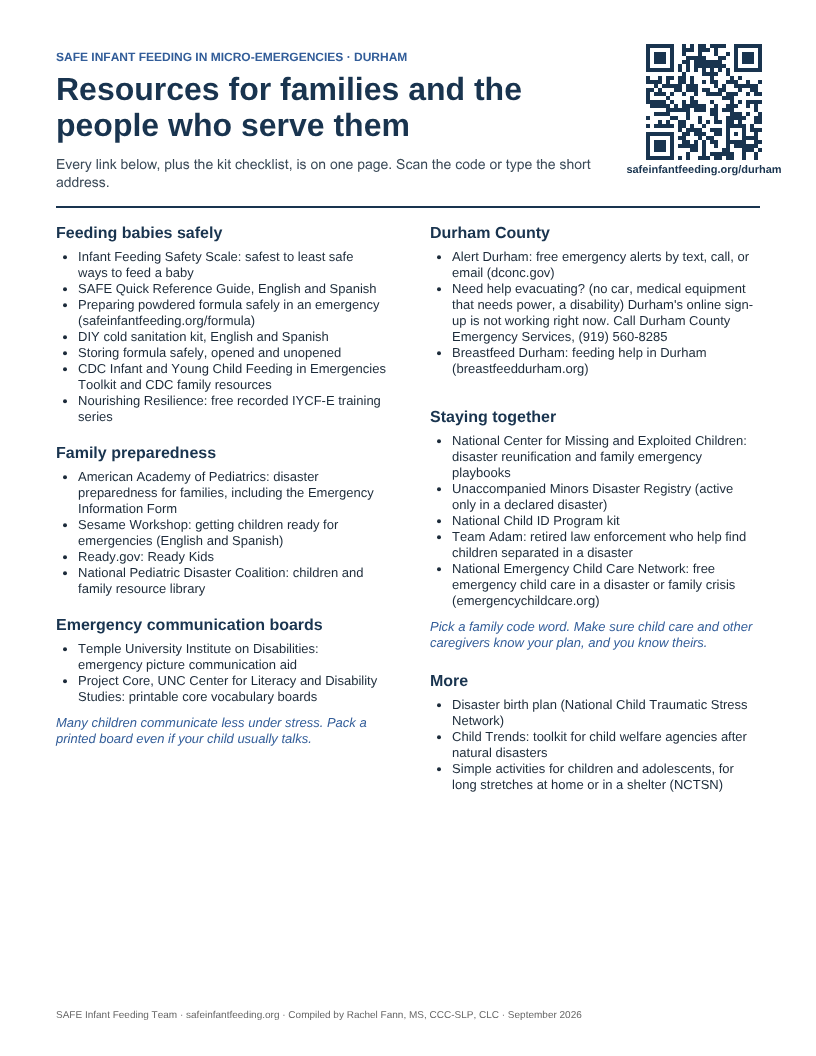
Print these for your fridge, your diaper bag, or a family member. Each is one page, in English and Spanish.
Feeding babies safely
- Infant Feeding Safety Scale: the safest to least safe ways to feed a baby.
- SAFE Infant Feeding Quick Reference Guide / Guía de referencia rápida: simple picture instructions, in English and Spanish.
- Preparing powdered formula safely in an emergency: the water temperature matters more than anything else.
- DIY cold sanitation kit / en español: clean bottles, pump parts, and cups without power or hot water.
- Storing formula safely: opened and unopened containers.
- Planning ahead for winter weather with infants and young children
- Short videos: Safe infant feeding in emergencies · Hand expression · Infant carrying · Keeping baby warm / en español
- CDC resources for families
- All SAFE Infant Feeding Team family resources
Let’s build a family emergency kit
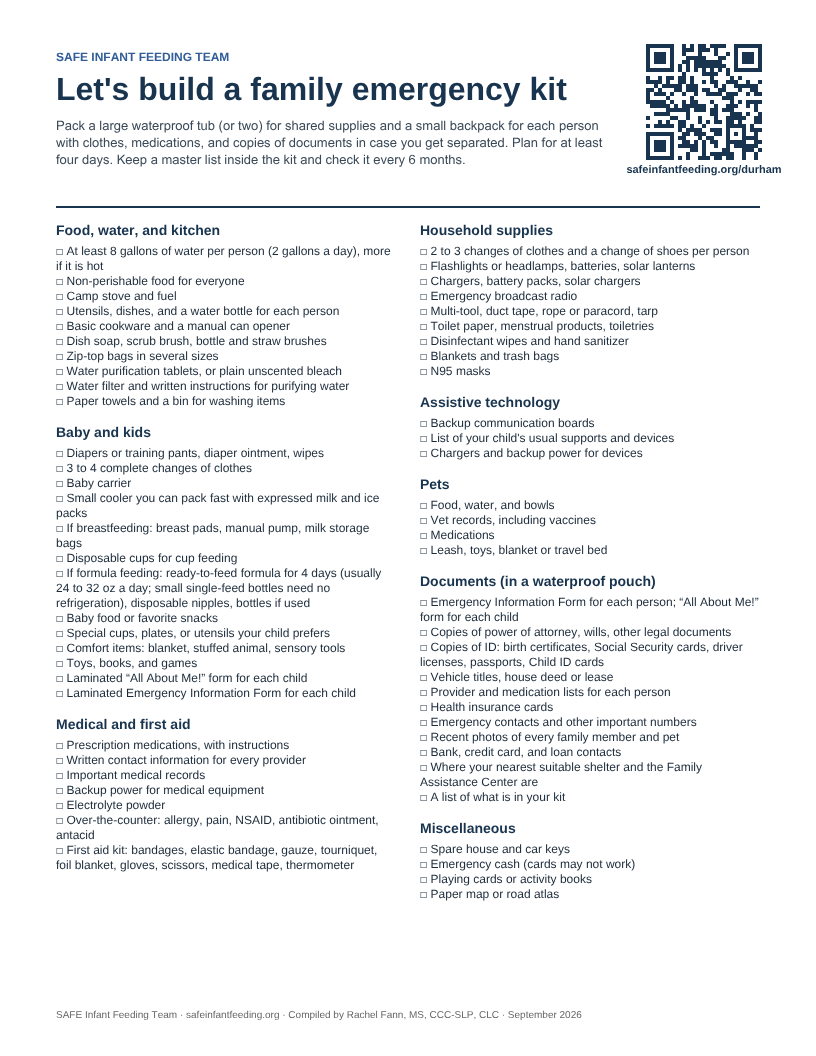
Most families pack a large waterproof tub (or two) for shared supplies and a small backpack for each person with their clothes, medications, and copies of documents in case you get separated. Plan for at least four days. Keep a master list inside the kit and check it every 6 months, or sooner when your family’s needs change. Tap each section to open it, or print the one-page checklist (en español).
Food, water, and kitchen
- At least 8 gallons of water per person (2 gallons per person per day), more if it is hot
- Non-perishable food for everyone in the family
- Camp stove and fuel
- Utensils, dishes, and a water bottle for each person
- Basic cookware and a manual can opener
- Dishwashing supplies: soap, scrub brushes, bottle and straw brushes
- Zip-top bags in several sizes
- Water purification tablets, or plain unscented bleach (nothing added) for purifying water
- Water filter, and written instructions for purifying water
- Paper towels and a bin for washing items
Baby and kids
- Diapers or training pants, diaper ointment, and wipes
- 3 to 4 complete changes of clothes
- Baby carrier
- A small cooler you can pack quickly with expressed breast milk and ice packs
- If breastfeeding: breast pads, a manual breast pump, and milk storage bags
- Disposable cups for cup feeding
- If formula feeding: enough ready-to-feed formula for 4 days (a fully formula-fed baby usually takes 24 to 32 oz a day; small single-feed bottles mean nothing has to be kept cold), disposable bottle nipples, and bottles if you use them
- Baby food or your child’s preferred snacks
- Any special cups, plates, or utensils your child prefers
- Comfort items: blanket, stuffed animal, sensory tools
- Toys, books, and games
- A laminated “All About Me!” form for each child
- A laminated Emergency Information Form for each child (the AAP has one to download)
Medical and first aid
- Prescription medications, with instructions
- Written contact information for every provider
- Important medical records
- Backup power for medical equipment
- Electrolyte powder
- Over-the-counter medications: allergy, pain, NSAID, antibiotic ointment, antacid
- First aid kit: bandages, elastic bandage, gauze, tourniquet, foil blanket, gloves, scissors, medical tape, thermometer
Household supplies
- 2 to 3 complete changes of clothes and a change of shoes for each person
- Flashlights or headlamps, batteries, and lanterns (solar is best)
- Chargers, battery packs, and solar chargers
- Emergency broadcast radio
- Pocket knife or multi-tool, duct tape, rope or paracord, and a tarp
- Toilet paper, menstrual products, and other toiletries
- Disinfectant wipes and hand sanitizer
- Blankets and trash bags
- N95 masks
Assistive technology
- Backup communication boards (see communication boards below)
- A list of your child’s usual supports and devices
- Chargers and backup power for devices
Pets
- Pet food, water, and bowls
- Veterinary records, including vaccines
- Medications
- Leash, toys, and a blanket or travel bed
Documents (in a waterproof pouch)
- An Emergency Information Form for each family member and an “All About Me!” form for each child
- Copies of power of attorney documents, wills, and other legal documents
- Copies of ID: birth certificates, Social Security cards, driver licenses, passports, National Child ID Program cards
- Vehicle titles and your house deed or lease
- Provider lists and medication lists for each family member
- Health insurance cards
- Emergency contacts and other important phone numbers
- Recent photos of every family member and pet, alone and together
- Bank, credit card, and loan contact information
- Where the nearest shelter that meets your family’s needs is, and where the Family Assistance Center will be
- A list of what is in your kit
Miscellaneous
- Spare house and car keys
- Emergency cash (cards may not work)
- Playing cards or activity books
- A paper map or road atlas
Family preparedness
- American Academy of Pediatrics: disaster preparedness for families, including the Emergency Information Form
- Sesame Workshop: helping children get ready for emergencies (English and Spanish)
- Ready.gov: Ready Kids
- National Pediatric Disaster Coalition: resources for children and families
Emergency communication boards
Many children have a harder time communicating under stress. Pack a printed board even if your child usually talks.
- Temple University Institute on Disabilities: emergency picture communication aid
- Project Core, UNC Chapel Hill Center for Literacy and Disability Studies: printable core vocabulary boards
Durham County
- Alert Durham: free emergency alerts by text, call, or email for the addresses you choose.
- Would someone in your home need help evacuating (no car, medical equipment that needs power, a disability)? Durham County keeps a voluntary list so they can help. If the sign-up gives you trouble, call Durham County Emergency Services at (919) 560-8285.
- Feeding help in Durham: the Breastfeed Durham Lactation Collaborative and lactation groups and classes
Staying together
Pick a family code word, and make sure your child’s caregivers and child care program know your emergency plan and theirs.
- National Emergency Child Care Network: free emergency child care for any family in a disaster or a personal crisis like a house fire, job loss, or medical emergency. Fill out their form online and trained volunteers come to you.
- National Center for Missing and Exploited Children: disaster preparedness and reunification, including family emergency playbooks in English and Spanish
- Unaccompanied Minors Disaster Registry (only active during a declared disaster)
- National Child ID Program kit
- Team Adam: retired law enforcement who help find children separated from their families in a disaster
More
- Disaster birth plan (National Child Traumatic Stress Network)
- Simple activities for children and adolescents, for any long stretch at home or in a shelter
En español
- Recursos para las familias y quienes las atienden (PDF de una página)
- Preparemos un kit de emergencia familiar (PDF de una página)
- Cuidado infantil de emergencia gratuito durante un desastre o una crisis personal: National Emergency Child Care Network (formulario en línea)
- Apoyo a la lactancia en español: Colaborativa de Lactancia, o llame al 919-646-5130 o al 339-225-1212
Home visitors and partner staff: the slides and notes from our September 28 training, SAFE Infant Feeding in Micro-Emergencies, are on the SAFE Infant Feeding Team site. For more, see Nourishing Resilience, our free recorded training series.
Resources and kit checklist compiled by Rachel Fann, MS, CCC-SLP, CLC, and the SAFE Infant Feeding Team, a project of Breastfeeding Family Friendly Communities, the organization behind Breastfeed Durham.