
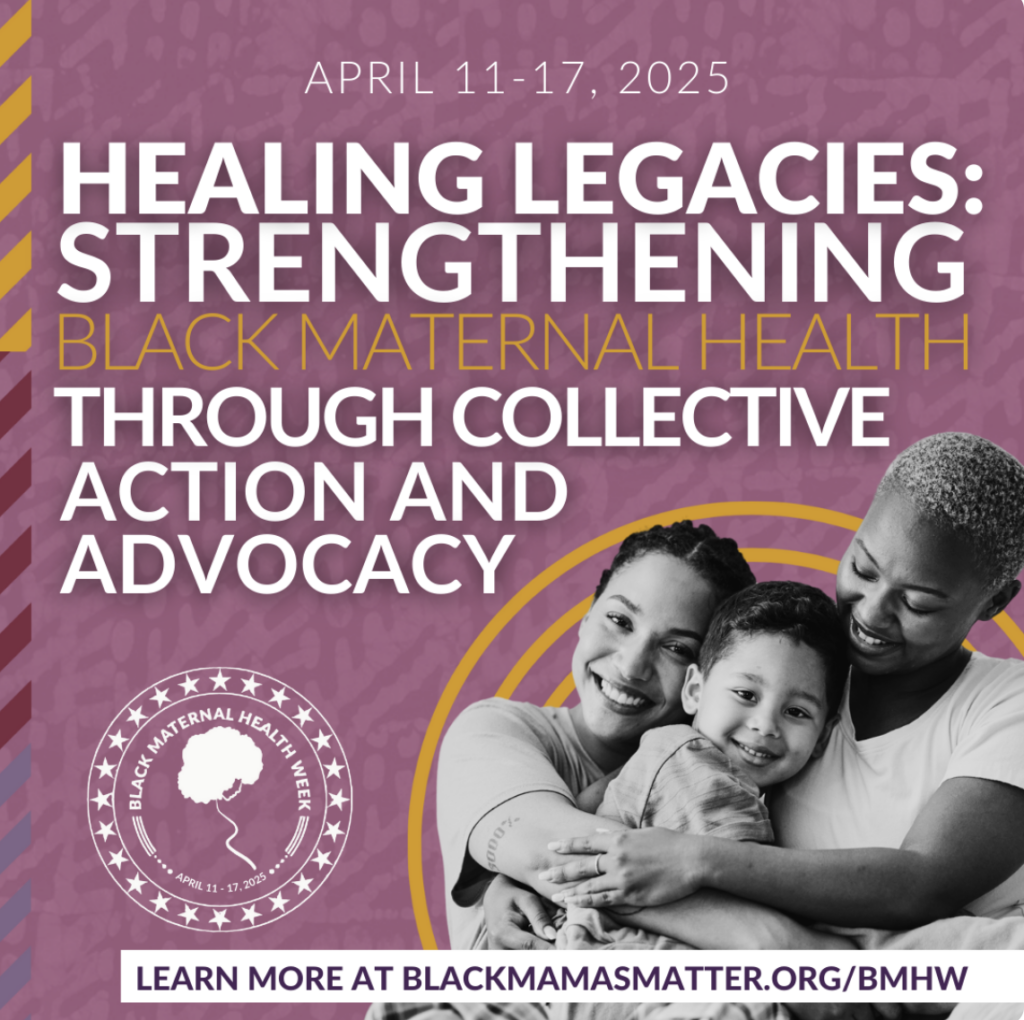
Every year from April 11 to 17, Black Maternal Health Week calls on all of us to listen to Black mamas and to act. The week was founded and is led by the Black Mamas Matter Alliance. Here is this year’s theme in their words, and the numbers that keep us doing this work.
The 2025 Black Maternal Health Week (BMHW25) theme, “Healing Legacies: Strengthening Black Maternal Health Through Collective Action and Advocacy,” emphasizes the power of Black-led perinatal, maternal, and reproductive health organizations to drive systemic change and foster community healing. The theme acknowledges the persistent legacies of systemic oppression(s), reproductive injustices, and health inequities that have disproportionately affected Black Mamas and people. It emphasizes the need for healing at both individual and community levels while addressing the need for restorative approaches to maternal health care. BMHW25 celebrates the leadership and expertise of Black community-based organizations as the foundation for advancing equity and ensuring transformative, sustainable improvements in Black Maternal Health. Advancing collective action highlights the essential role of collaboration between Black-led organizations, advocates, and communities to lead advocacy efforts, shape policies, and amplify solutions. This week underscores the necessity of Unity and the Power of Community to create a future where Black Mamas, families, and communities, Thrive!
Black Mamas Matter Alliance
Held annually on April 11-17th, BMHW is a week-long campaign founded and led by the Black Mamas Matter Alliance to build awareness, activism, and community-building to amplify the voices, perspectives and lived experiences of Black Mamas and birthing people. The week is intentionally held during National Minority Health Month and begins on April 11th annually to join dozens of global organizations in marking this day as International Day for Maternal Health and Rights, an opportunity to advocate for the elimination of maternal mortality, globally. The activities and conversations hosted throughout the week intentionally center the values and practices of the birth and reproductive justice movements.
Black Mamas Matter Alliance
Maternal mortality and pregnancy-related death
- In 2023, the maternal mortality rate for non-Hispanic Black women was 50.3 deaths per 100,000 live births, nearly 3.5 times the rate for non-Hispanic White women (CDC, 2025).
- In the U.S., Black women are three times more likely to die from a pregnancy-related cause than White women. CDC notes that more than 80% of pregnancy-related deaths are preventable (CDC, 2024).
Breastfeeding
- Approximately one in four women must return to work within 10 to 14 days after giving birth (NIH, 2020). The lack of paid leave makes it much harder to bond with a new baby, heal from birth, and provide human milk.
- Infants in rural areas are less likely to ever breastfeed than infants living in urban areas (CDC, 2024).
- About 74.5% of Black infants are ever breastfed, compared with 86.2% of white infants and 83.4% of Latinx infants (CDC, 2024).
What we can do in Durham
These gaps are not about Black families. They are about systems: paid leave, hospital practices, and who gets support when it matters. Breastfeed Durham works to change those systems so that every Black family in Durham gets the care, time, and community support they deserve. Find local support through our Black Breastfeeding Coalition and our Black Perinatal Resources, and follow the week’s events at blackmamasmatter.org.