Black Breastfeeding Week turns 14 this year. The 2026 theme is “We All We Got: 14 Years of Community, Care, and Collective Power,” and I cannot think of a truer set of words. For folks who have been navigating systemic racism from birth to death, we get it. We save each other. Our milk, our knowledge, our aunties and grandmothers and neighbors and doulas: what we’ve got is collective power.
That is the lens I want to use to tell you about something that happened to me this month, because on its own it is just an award, but through the lens of collective power it is a story about all of us.
An award that belongs to the collective
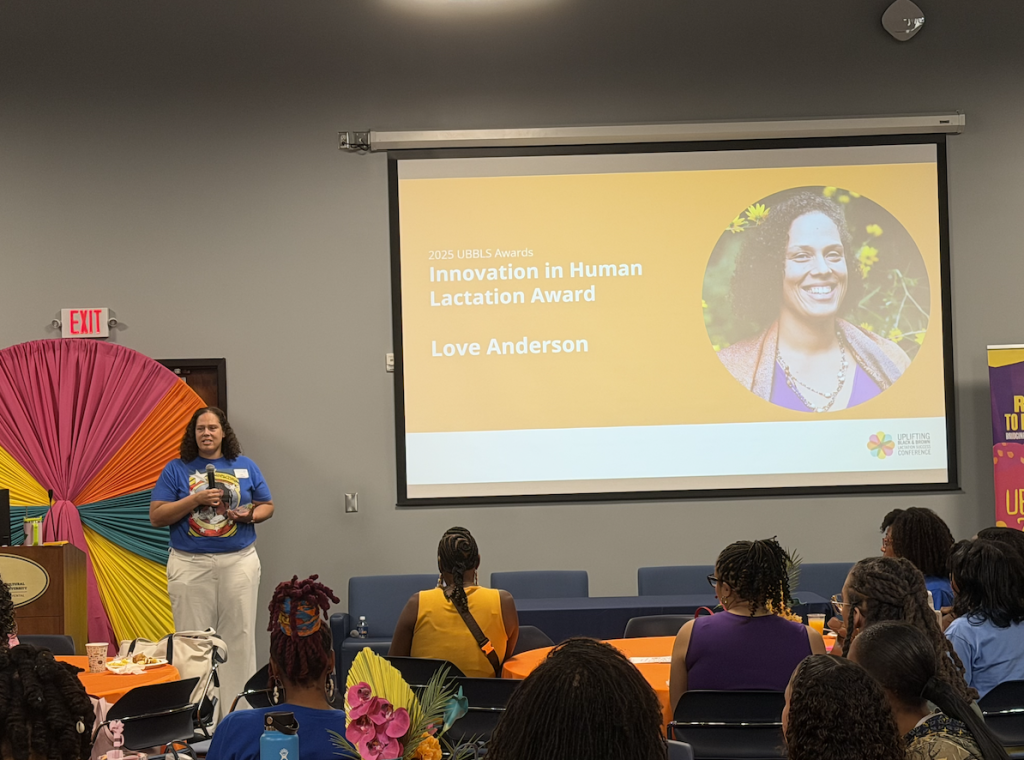
At the Uplifting Black and Brown Lactation Success (UBBLS) Conference at North Carolina A&T a few weeks ago, I received the Innovation in Human Lactation Award. When I sat with that name, I understood what it was really recognizing. This award is about the work after Hurricane Helene, standing up support for clinicians and families in Western North Carolina, and bringing national attention to a policy gap that should never have existed: infant and young child feeding in emergencies.
But an innovation award for emergency response tells on this country, if you listen closely. Here is what it tells.
The emergency was never just the hurricane
If we had the infrastructure to support families through the micro-emergencies that happen every single day, the ones the Black community is so acutely aware of as a result of systemic racism, there would have been no need for innovation when Helene hit. A power outage in an apartment complex. A boil-water advisory. An eviction. A pump that breaks the week a mother goes back to work. An empty formula shelf on the one night the bus is running. These are emergencies too. They just don’t make the news.
Black families have never had the luxury of waiting for systems to show up, so they built their own: the auntie who knows how to hand express, the church that opens its doors, the neighbor who watches the baby, the peer counselor who answers the phone at midnight. That is collective power, and it is one of the oldest emergency response systems in America. Our work in Durham has always been about honoring and resourcing that system, building community-based, family-friendly support that exists before the disaster, so nothing has to be invented during one. Hurricane Helene didn’t reveal a new problem. It revealed, at scale, the problem Black families have been navigating quietly all along, and it proved that the community-rooted model works. If this award means anything, I hope it means the nation is finally ready to invest in what these communities have always known how to do: keep families fed.
The fathers who asked the question
My most poignant moment at the conference wasn’t the awards ceremony. It was a conversation with the fathers who were there, Black men doing the work of showing up for their families, who asked the rest of us a direct question: is your organization welcoming to dads, and particularly to Black men?
I spent a long time talking with them, and I had to tell the truth: we could be more welcoming. They pointed out that our classic logo doesn’t include a partner. And they’re right. When we created it, we were intentional about something that mattered deeply to us, recognizing a mom and a baby, on their own, as a whole family. That intention still matters. And at the same time, these fathers reminded me that collective power is not collective if anyone is left standing outside the circle. Fathers and partners are not on the sidelines of the lactation journey. They are protectors and essential members of the care team. I’m carrying their question home with me, and I’m grateful to them for asking it.
Fourteen years of building
Just a few short years ago, the shortage of Black lactation consultants in North Carolina was a full-on crisis. This week, I get to write something different: there are so many more Black and culturally competent IBCLCs in our state than there were, and that is no accident. That is collective power with receipts.
Johnson C. Smith University blazed the trail as the first HBCU in the country to offer a lactation consultant training program. North Carolina A&T’s Human Lactation Pathway 2 Program picked up that torch and has been graduating cohort after cohort of brilliant lactation professionals, and built UBBLS, the first lactation conference ever hosted at an HBCU, so this growing community has a home. Standing over all of it is the legacy of leaders like Dr. Kimarie “Mama Bugg” Bugg, the first Black IBCLC, and Reaching Our Sisters Everywhere (ROSE), who co-host that gathering every year. Fourteen years of Black Breastfeeding Week, and look what the community built in that time: a pipeline, an institution, a family.
That is what I’m celebrating this week. Not an award. A movement. A state where a Black family seeking lactation support is more and more likely to be cared for by someone who looks like them, understands them, and never makes them explain themselves first.
With gratitude
Thank you to the UBBLS Scholarships and Awards committee, to the NC A&T Human Lactation Pathway 2 Program, to ROSE, and to everyone who organized, sponsored, and showed up. Thank you to the SAFE team and the whole Breastfeeding Family Friendly Communities family; this recognition belongs to all of us. And thank you to the fathers who asked the hard question.
Fourteen years of community, care, and collective power. May this week be a celebration of everything that has been built, and a promise about what comes next.
Happy Black Breastfeeding Week.
Love Anderson
President & CEO, Breastfeeding Family Friendly Communities