By Nicola Bronson, MPH Candidate
UNC Gillings School of Global Public Health
Field Placement with Breastfeed Durham, Summer 2026
My name is Nikki, and I have spent the last ten weeks working as Breastfeed Durham’s
Business Outreach Coordinator. In practice, this meant walking through Durham neighborhoods
and knocking on the door of every church, restaurant, retail store, coffee shop, doctor’s office,
etc. to talk to them about the importance of breastfeeding and what it means to create a safe
environment for breastfeeding parents. I conducted this work in pursuit of achieving Step 7 of
the World Health Organization’s Ten Steps to a Breastfeeding Family Friendly Community:
recognizing businesses that actively welcome breastfeeding parents and strive to create a
supportive environment for all breastfeeding patrons and employees. While most of my role
consisted of educating business owners on the stigma surrounding breastfeeding and how they
can reduce it, I found that I learned more from the community than I could have imagined.
One aspect of business outreach that truly surprised me was how many men were
supportive of our cause. When I first began going knocking on doors in downtown Durham, I
often hesitated while standing outside male-owned businesses. I would see the owner through
the window and try to gauge how friendly he looked, or if it seemed like talking about breasts
and breastfeeding would make him uncomfortable. If I’m being completely honest, I often
wanted to skip businesses that appeared to have majority male employees when I began this
project in May. However, once I pushed past my own prejudice, I found that men were often
overjoyed to support our cause. They enthusiastically recounted how their wives or partners
breastfed their children and how these breastfeeding journeys affected their families. Some
lamented the isolation and discomfort their lactating partners experienced when they were forced
to pump in their car due to the lack of private pumping space in their workplaces. Others spoke
about the joy their wives felt when they were able to successfully breastfeed their infant after
weeks of latching difficulties. One man described breastfeeding as a prominent feature of his
childhood; he remembers his mother constantly breastfeeding his younger siblings throughout
his youth. He was shocked to learn about the stigma surrounding breastfeeding as he got older,
as it had been a completely benign, unremarkable feature of his adolescence. Overall, men and
non-lactating significant others spoke of their breastfeeding partners and the act of breastfeeding
with reverence and respect.
This was a valuable lesson for me. Throughout my public health coursework, many
professors have warned me against overlooking or disregarding fathers and their role in family
health. While maternal and child health professionals often focus solely on mother and baby
when researching breastfeeding, refusing to include men and fathers and the support they can
provide to their lactating partners only serves to reinforce traditional gender roles. Despite being
aware of this bias, I still felt myself gravitating towards women-owned and operated businesses
and neglecting primarily male-owned industries in my early business outreach efforts. As more
and more men displayed their support of Breastfeed Durham’s work, whether it was excitedly
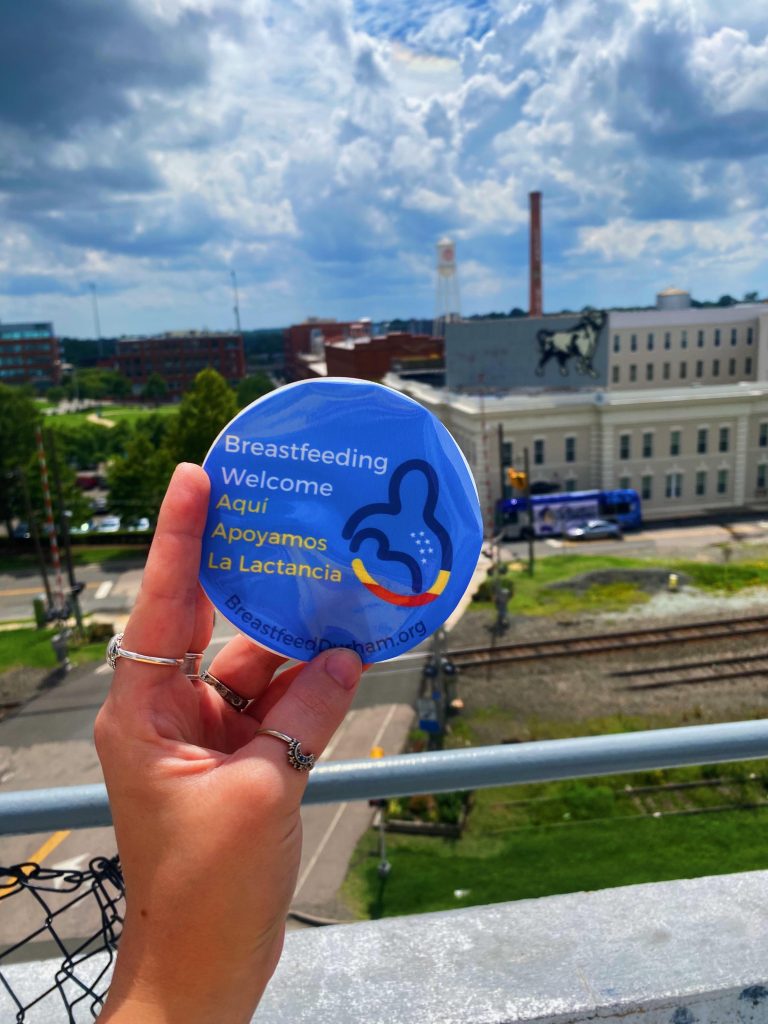
showing me their private lactation space or enthusiastically putting our “Breastfeeding Welcome
Here” sticker on their door before I could even finish my pitch, I was able to confront my bias
and appreciate the role that fathers and non-lactating partners serve in the support and promotion
of breastfeeding.
Another foundational lesson that I learned this summer was the importance of in-person
connection. Throughout this practicum experience, I devoted 2/3 of my time to in-person
business outreach and 1/3 to virtual outreach. I could typically reach hundreds of businesses in
one day of virtual outreach, compared to 15-30 businesses per day during in-person outreach.
Based on numbers alone, I figured I would have significantly more success from my virtual
outreach efforts than my in-person work. However, the opposite turned out to be true. I found
that forming a connection and creating a space where business owners could tell me about their
personal breastfeeding journey and the struggles they faced allowed us to build a relationship
based on mutual trust and respect. Further, it allowed me to gain a deeper understanding of the
taboo (or lack thereof) surrounding breastfeeding across different cultures. Many business
owners from different cultural backgrounds spoke about how normal and natural breastfeeding in
public was in their families and their communities, while others discussed the pressure they felt
to cover up or hide away while breastfeeding their infant. This allowed me to appreciate
Durham’s diverse population and the perspectives they bring to Breastfeed Durham’s efforts.
Over the course of this hot, humid North Carolina summer, I had the privilege of
discussing the first source of nutrition that so many of us encountered as we entered the world.
The middle of the night, sleep-deprived feedings that connect every lactating parent to one
another since time immemorial, whether illuminated by fluorescent bulbs, candlelight, or
moonlight. As such, it is fitting that the reoccurring theme throughout my work this summer was
connection. When I approached business owners as a salesperson, cold and direct, I had little
success in recruiting them as community partners. When I approached them as myself, gave
them space to talk about their breastfeeding journeys and how our society treated them while
they fed their infants, a bond formed. It created a space where they could learn from our
organization, but more importantly, a space where I could learn from them. Large scale shifts in
public health, such as widespread acceptance of breastfeeding in public, are slow, arduous
processes. However, they start in small interactions, such as those between business owners and
I. They start in connections between parent and infant, and between the community and
grassroots organizations like Breastfeed Durham. I am so grateful to Breastfeed Durham and the
Durham community for allowing me to create some of these vital connections.