By: Love Anderson — Indigenous Milk Medicine Week — August 8 to 14, 2026
I want to start with the worst number in North Carolina, and then with the numbers we do not have. In North Carolina, 52.1% of American Indian and Alaska Native families start out breastfeeding.
Sit with that. In the same state, in the same year, Asian families were at 89.0%, Hispanic families at 88.1%, white families at 84.6%, Native Hawaiian and Pacific Islander families at 82.7%, and Black families at 70.8%. North Carolina overall was 81.6%.
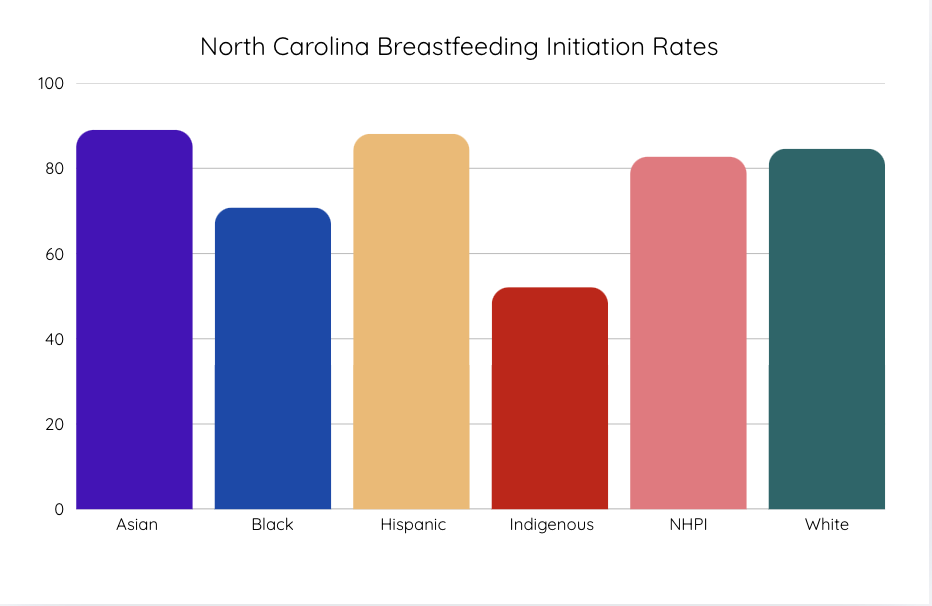
Indigenous families are 18.7 points below the next lowest group in this state, and 25.6 points below the national Indigenous rate of 77.7%. North Carolina’s largest racial gap in breastfeeding initiation is 36.9 percentage points. It is not close, and it has been sitting in a CDC table since 2021. That is the number we have. Here is what we do not have.
Ask how many of those babies were still breastfeeding at six months, and the honest answer is that nobody can tell you. The national survey estimate for American Indian and Alaska Native families at six months is 52.2% — with a margin of error of plus or minus 11.4 points. The true figure is somewhere between 41% and 64%, which is not a measurement so much as a shrug. For white families the same survey reports 65.5%, give or take 1.5. In the previous year’s data the Indigenous cells were not published at all; every other racial group had a number, and where Indigenous families should have been, the table read NR. Not reported. Narrow the question to North Carolina and there is nothing.
The most recent published NC PRAMS data, from 2020, report four racial and ethnic groups: Non-Hispanic White, Non-Hispanic Black, Non-Hispanic Other, and Latina. Indigenous families in this state are included in the word “Other.” And in 2025, the CDC retired the Breastfeeding Report Card entirely; its replacement reports by state with no racial breakdown at all. So this is where we begin Indigenous Milk Medicine Week 2026. Roughly 300,000 people in North Carolina identify as American Indian or Alaska Native, alone or in combination — the largest such population east of the Mississippi River. Eight state-recognized tribes, two of them also federally recognized: the Eastern Band of Cherokee Indians, on the Qualla Boundary, and the Lumbee Tribe, recognized in December 2025 after a fight that lasted more than a century.
We know Indigenous families in this state start out breastfeeding at little more than half the rate of their neighbors. We have almost no idea what happens to them after that.
You cannot close a gap you refuse to measure.
What the week is, and what it is called. This year’s theme is “We Keep the Fires Lit: Rising Through Milk Medicine.”
The week is organized by the Indigenous Milk Medicine Collective, whose mission is “to support the brilliance of Indigenous parents, caregivers, and communities in celebrating their Milk Medicine journeys to honor and strengthen their self-determination.” The week was founded in 2019 by Jasha Lyons Echo-Hawk (Seminole + Pawnee + Creek + Omaha + Iowa) as Native Breastfeeding Week, and renamed by 2021. The rename matters, and I want to let the founder explain it in her own words. The organizers learned,through community feedback, “how exclusive and harmful it could be to all of our kin milk medicine-makers.” So they “knew we had to rename and call back a particular medicine space.” Milk medicine rather than breastfeeding. It is a wider door — for Two Spirit and trans parents, for adoptive and non-gestational parents, for people who feed by means other than the breast. And it is a refusal to let a clinical English verb stand in for something Indigenous communities have always understood as medicine. We are following the Collective’s lead on that language, and we would ask our partners to do the same.
Even the number we have is shaky.
The 52.1% and the national 77.7% both come from birth certificates. And vital records systematically misclassify Indigenous people. The National Center for Health Statistics found that only 51.4% of people who identified as American Indian or Alaska Native during their lifetime were correctly recorded as AI/AN on their death certificate. Nearly half were recorded as something else. NCHS applies a correction factor of 1.40 to AI/AN death counts as a result, and that ratio has barely improved since 1979. Researchers at UNC documented the same problem specifically in North Carolina death records. Birth certificates use a different process — race is normally reported by the mother on a hospital worksheet, not by a funeral director — so the death certificate finding does not transfer directly, and I have not found research establishing which way birth record error moves the breastfeeding numbers. But birth records have their own well-documented race reporting problems, and the 52.1% is built entirely on them. Misclassification on vital records. Estimates too imprecise to use in national surveys. “Other” categories in state data. Three separate mechanisms, one result. Native families disappear from the count.
Where the gap comes from: People ask why Indigenous breastfeeding rates are lower.
Let me be precise about the evidence first, because it matters. I am not aware of a peer-reviewed study that quantifies a causal link between federal Indian boarding schools and breastfeeding rates. What exists is the federal government’s own documentation of the separations, a substantial research literature on the intergenerational transmission of residential school trauma, and the consistent testimony of Indigenous lactation professionals. That is not proof of causation. It is, I think, more than enough to take seriously.
Here is the documented record. The U.S. Department of the Interior’s investigation identified 417 federal Indian boarding schools operating across 37 states and territories between 1819 and 1969. At least 973 Native children died at those schools. Investigators found at least 74 marked and unmarked burial sites at 65 different school sites. The federal government made more than $23.3 billion, inflation-adjusted, available to run the system. The report describes the purpose plainly: the “twin goals of cultural assimilation and territorial dispossession of Indigenous peoples,” achieved through “family separation and cultural eradication inflicted upon generations of children as young as 4 years old.”
It documents the conditions: “rampant physical, sexual, and emotional abuse; disease; malnourishment; overcrowding; and lack of health care.” A federal inspection of the era noted “the outstanding deficiency is in the diet furnished the Indian children, many of whom are below normal health.” At one school, three children to a bed. And it quotes the government’s own contemporaneous understanding of what it was destroying: “The love of home and the warm reciprocal affection existing between parents and children are among the strongest characteristics of the Indian nature.”
They knew. They wrote it down. And they did it anyway. Here is what a lactation professional should understand about that. A child taken at four years old does not spend her childhood watching her mother and her aunties and her grandmother feed babies. She does not absorb, the way children absorb everything, how a baby latches or how long a feed takes or what you do when your milk is slow. When she has her own child, she has no one to ask — and neither did her mother. Do that for four generations and what gets handed down has to be rebuilt rather than remembered. Indigenous lactation professionals have beenmaking this argument for years.
Ashley Sayers (Ojibwe, IBCLC) names the full sequence: “Generations of government-mandated boarding school attendance for all Native children, mass forced sterilization, ongoing violence against Native American women, excessive incarceration rates and family severance, disproportionate removal of Native American children from our familial units and cultures.” She frames Indigenous breastfeeding as “a political act of resistance.”
What I am not going to pretend I’m outside of I should tell you where I stand, because this is a week that belongs to Indigenous milk medicine makers and I am about to talk about my grandmother. I am multiracial: Black, Cherokee, and Scots-Irish. I am not a citizen of the Cherokee Nation, or of the Eastern Band, or of the United Keetoowah Band. I am not enrolled anywhere, and I am not claiming a nation. My family is Cherokee the way a great many families across the South are Cherokee — by descent, by memory, and by paperwork that was lost or was never filed.
Here is the version I have.
My grandmother’s people were Cherokee who ended up in Arkansas. Somewhere between these mountains and there, they came off the removal. The way my family says it is that they fell off. They did not finish the walk to Indian Territory. My grandmother’s mother’s mother, as best we can tell, was listed on one of the big federal rolls that came out at the turn of the last century — the ones that asked Cherokee people scattered all over the country to document descent from somebody who had been forced to march. They were farm workers. Migrant farm workers, following the season. What they wanted to be was musicians, and that is how they came to be near Nashville. Then my great-grandfather died — and a widow with a houseful of children in the Great Depression is a woman that institutions take children from. So my grandmother and her younger siblings were taken. She went to one of the schools. She was hungry there. She was whitewashed there. She cried for her mother there. And she was not able to find her way back to her family until she was in her forties. That is how completely it was severed. I only learned who her people were because one of her siblings got the records unsealed during a lawsuit, because she had cancer.
My grandmother was loving and kind and service-oriented. She was also a person who had absorbed a great deal of physical trauma as a child, and she found it very difficult to let children be children. She never got to learn how to mother from her mother. That disruption in the maternal line reaches forward and touches how
I mother, right now, today. I am not speaking for Indigenous milk medicine makers and I would not presume to. What I am telling you is that the mechanism this entire post is about — the removal, the severed line, the knowledge that has to be rebuilt because it could not be handed down — ran straight through my family and out the other side into my kitchen. It is also why I know what the counting problem feels like from the inside. On a form, I am multiracial. In a chart, I am whatever the person holding the pen decided. Durham’s Indigenous community is small and largely invisible in exactly this way, and it is also multiracial and it includes many Indigenous families from Mexico and Central America, who are counted differently and erased by an entirely different mechanism.
The fires are lit.
I do not want to end on deficit, because that is not what this week is.
On July 28, 2026 — eleven days before Indigenous Milk Medicine Week — the Eastern Band of Cherokee Indians WIC Program was named a USDA WIC Breastfeeding Award of Excellence Premiere recipient. That is the top tier, and it is the first time EBCI has reached it, after two Gold Awards in the past decade. “This award celebrates a team whose dedication goes beyond service,” said WIC Program Manager Kim Lambert. “The collective effort of our staff who work every day to ensure families have the resources they need demonstrate the passion, commitment, and care to empower families to achieve healthier futures.” The program runs out of the Beloved Women and Children’s Health and Wellness Center in Cherokee, with peer counselors providing mother-to-mother support. Read that again. In a state where Indigenous families start out breastfeeding at 52%, a tribal WIC program just won the nation’s highest breastfeeding honor.
And from August 3 to 7, while most of the country had not yet noticed it was National Breastfeeding Month, thirty Indigenous community members sat in a room in Cherokee, North Carolina, from nine to five, five days running, forty-five hours, and became Certified Indigenous Lactation Counselors. The training was hosted by The Center for Native Health, a Cherokee-based nonprofit founded in 2008 whose mission is “to support balanced wellbeing of southeastern Native communities through the preservation and respectful application of Native knowledge to empower the people, Land, and culture.” It is led by Trey Adcock, PhD, an enrolled citizen of the Cherokee Nation. It was free, breakfast and lunch included, funded by the CDC, and open to self-identified Indigenous community members only. Bernadette and I are sick about missing it. We had already bought tickets to the Uplifting Black and Brown Lactation Success Conference the same week, and by the time the training dates were published, the money was spent. Had we known, we would have chosen differently. Thirty people, five days, forty-five hours, ninety minutes up the road from a state that has never published a number for them — and we were somewhere else.
The curriculum exists because Camie Jae Goldhammer, MSW, LICSW, IBCLC (Sisseton-Wahpeton Oyate) — the first Native American IBCLC in Washington state, in 2013 — cocreated the first lactation counselor training program developed by and for Native communities. She now runs it with Kimberly Moore-Salas, IBCLC (Dine). Both serve as Program and Education Co-Chairs of the Indigenous Milk Medicine Collective. More than 550 Indigenous Lactation Counselors have been trained. As the flyer puts it, once certified they will “have the clinical skills to begin serving lactating families in their community and help families provide their babies with their first sacred food.” Now hold two facts next to each other. The funding for that training in Cherokee came from the Centers for Disease Control and Prevention. The same agency whose national survey cannot produce a usable six-month breastfeeding estimate for Native families, and which retired the report card that would have shown you the gap, paid to train thirty Indigenous lactation counselors in western North Carolina this week. That is not hypocrisy. It is a federal government that is willing to fund the solution and unwilling to count the problem. The counting is the cheaper half. It is worth adding that the Indigenous Milk Medicine Collective’s Community Outreach lead, Brittnee Arch, is Eastern Band Cherokee and Navajo. The national organizing body has North Carolina in it. So does the work.
What we are asking:
- Say the right name. It is Indigenous Milk Medicine Week. It is milk medicine. And the credential is the
Indigenous Lactation Counselor — the older name, Indigenous Breastfeeding Counselor, is still sitting in
the web address of the page that describes it.
- Support the training pipeline. There is no published count of Indigenous IBCLCs in this country, because
IBLCE does not collect race data on certificants. What we know is that every Indigenous Lactation
Counselor trained is a person a Native family can actually reach.
- Demand disaggregated data. The most recent published NC PRAMS data reports four race and ethnicity
groups, and Indigenous families are inside “Other.” Ask NC DHHS why. Ask the CDC why the national
Indigenous estimate carries a margin of error five times wider than the one for white families.
- Fix misclassification at the source. Birth certificate race recording is a hospital workflow problem before
it is a statistics problem. Every birthing facility in this state can improve it this year.
- Ask why 52%. That number has been public since 2021 and North Carolina has not, to my knowledge,
done anything about it.
Support The Center for Native Health, at centerfornativehealth.org, which brought thirty new Indigenous
Lactation Counselors into this state this month.
Follow and fund the Collective, whose theme this year is We Keep the Fires Lit:
indigenousmilkmedicinecollective.org